Why 5-Inch Shorts Ride Up on Some People and Never on Others
Quick Answer: Five-inch shorts ride up when the hem lands at the widest part of your thigh rather than below it — at that position, every step pushes the fabric toward the narrower area above, and it stays there. Whether that happens depends on your thigh length and shape, not your size, which is why two people in the same size have opposite experiences.
Once you understand that the hem needs to sit past the widest point, choosing an inseam becomes a measurement question rather than a guessing game.

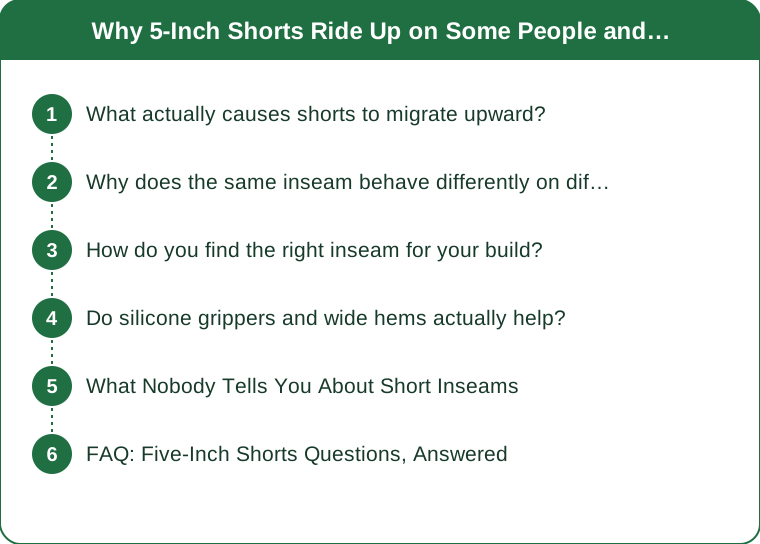
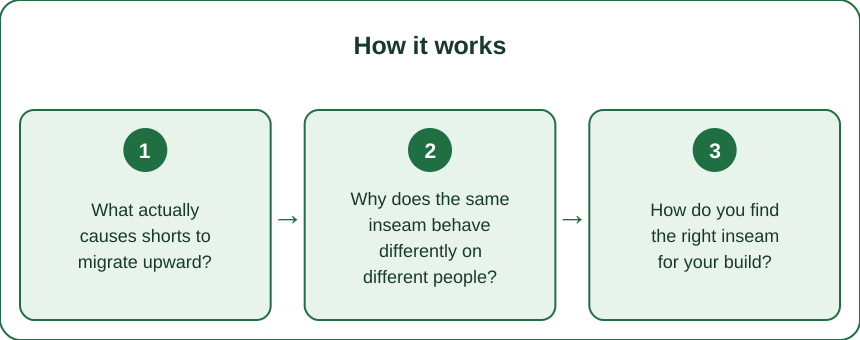
What actually causes shorts to migrate upward?
It’s a simple mechanical effect. Fabric under tension always moves toward the narrower part of a cone, and your thigh is essentially a cone that narrows as it goes up. When the hem sits right at the widest point, the fabric is at its maximum stretch there — and the moment you move, that tension resolves by sliding the hem upward, where the circumference is smaller and the fabric can relax.
Once it’s up, it stays up, because there’s no force pushing it back down. This is why ride-up gets worse over the course of a workout rather than staying constant.
Why does the same inseam behave differently on different people?
Because inseam length is measured from the crotch, but the widest part of your thigh sits at a different distance from the crotch depending on your build. On a longer thigh, five inches lands well above the widest point — a guaranteed ride-up. On a shorter thigh, that same five inches can land below it, and the shorts stay put all session.
Thigh shape matters as much as length. A build where the thigh tapers gradually gives more forgiving hem positions; a build where the widest point is high and pronounced narrows the window considerably. Neither is about being a larger or smaller size.
How do you find the right inseam for your build?
Measure rather than guess. Stand relaxed and find the widest point of your thigh by feel, then measure from your crotch straight down to about an inch below that point. That number is your minimum functional inseam.
For most people the answer lands somewhere between five and eight inches. If your measurement comes out at six and a half, a five-inch short will ride up no matter how good the fabric is — this is a geometry problem that a grippy hem can only partly compensate for. Buying an inseam that clears your widest point is a permanent fix rather than a workaround.

Do silicone grippers and wide hems actually help?
They help meaningfully, but they’re managing the symptom. A silicone gripper increases friction against the skin so the fabric resists the upward slide — this works well when the hem is only marginally misplaced and fails when the hem is well above the widest point, because the tension eventually overwhelms the grip.
A wide, bonded hem band works better than a thin elastic one because it distributes the holding force across more surface area rather than digging into one line. The combination of a correct inseam plus a wide hem is what actually solves it. The gripper alone, on the wrong inseam, just means the shorts ride up slightly more slowly.
What Nobody Tells You About Short Inseams
Compression level changes the effective fit. A high-compression five-inch short grips the thigh harder and resists migration better than a relaxed one at the same length — so two identical inseams from different brands genuinely perform differently.
Ride-up worsens with sweat. Damp skin reduces friction between the hem and your leg, which is exactly why shorts that behave for the first ten minutes start creeping later in a session.
Sizing up rarely helps and often hurts. A looser short has less grip and more fabric to bunch, so it migrates more, not less. If the inseam is right and it still rides, the issue is usually too little compression rather than too little room.
FAQ: Five-Inch Shorts Questions, Answered
Are 5-inch shorts long enough to prevent thigh chafing?
Only if the hem clears your widest point and stays there — a short that rides up exposes exactly the area you were trying to protect. For chafe prevention specifically, err longer.
Do biker shorts and running shorts use the same inseam standard?
Roughly, but running shorts are often measured with the waistband at a different rise, so the same stated inseam can land differently. Compare on-body, not on the tag.
Is it worth hemming shorts that are too long?
Rarely — most performance hems are bonded or feature a gripper strip that can’t be reproduced by a standard hem. Better to buy the right length.
TL;DR:
- Shorts ride up when the hem sits at the widest part of your thigh, not below it
- Measure from crotch to an inch below your widest thigh point to find your true minimum inseam
- Silicone grippers and wide bonded hems help, but can’t overcome a fundamentally short inseam
- Sizing up usually makes migration worse, not better
Ride-up is geometry, not sizing. Measure once and the five-inch-versus-seven-inch debate resolves itself for good.
See It in Motion
Seen here: High Waist Yoga Leggings with Inner Pocket — shop it on bubblelime.com
Keep Reading
This article is for general informational and styling purposes only. Fit, sizing, and product availability may vary.