Five Inch Shorts Sizing When You Are Between Two Sizes
Quick Answer: With a five inch inseam, size up if your thighs are the wider measurement, size down if your waist is. The short inseam means the leg opening sits at the widest part of your thigh, so a too-small short rides up almost immediately, while a too-large one gapes at the waist but stays put. If you cannot decide, size up and add a drawstring - a loose waist is a fixable problem and a tight leg opening is not.
Between-sizes advice for activewear is usually written for leggings, where sizing down is often right because the fabric stretches along the whole leg. A five inch short is a completely different geometry, and the same advice gives you the wrong answer.

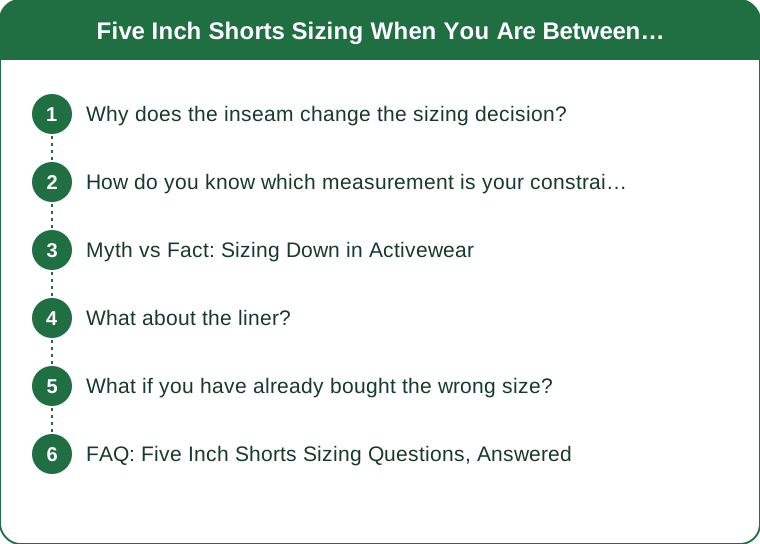
Why does the inseam change the sizing decision?
Because of where the leg opening lands on your body.
On a 7 or 9 inch short, the hem sits partway down the thigh, on a section that is narrower than the top of the leg. There is room, the hem is not fighting anything, and sizing is essentially a waist decision.
On a five inch inseam, the hem sits close to the widest part of the thigh on most people. That is the single most important fact about the length, and it drives everything else. The leg opening is now the constraint, not the waist.
What happens when the opening is too tight is predictable: the short rides up to find a narrower part of the leg, which shortens an already short inseam and creates the chafing and the constant tugging that people complain about.
What happens when the waist is slightly too loose is much less consequential - a drawstring fixes it entirely, and most five inch shorts have one.
So the asymmetry is real: too tight in the leg is a design failure you cannot fix. Too loose in the waist is a thirty-second adjustment.
How do you know which measurement is your constraint?
Take two numbers and compare them to the size chart, in this specific order.
Measure your thigh at the widest point, standing, relaxed. Not mid-thigh - right at the top, where the hem of a five inch short will actually sit.
Measure your natural waist where the waistband will land - which for most current five inch shorts is high, at or above the navel.
Now check both against the brand’s chart. Whichever measurement falls into the larger size is the one that decides. If your thigh says large and your waist says medium, buy the large. If your waist says large and your thigh says medium, buy the medium and use the drawstring.
A shortcut if you do not want to measure: think about your existing shorts. If the hems of your current shorts leave a mark on your thigh after an hour, your thigh is the constraint and you should size up. If your shorts slide down when you run, your waist is the constraint.
One complication worth knowing: lined shorts run smaller than unlined ones at the same nominal size, because the liner adds a second layer of compression exactly at the thigh.
Myth vs Fact: Sizing Down in Activewear
Myth: Sizing down gives you more compression and better support. Fact: It gives you more compression in the places the fabric can still stretch and a hard limit in the places it cannot. On a short inseam, that limit is the leg opening, and hitting it means the garment migrates.
Myth: They will stretch out after a few wears. Fact: Modern activewear knits are engineered for recovery - they are specifically designed not to stretch out permanently. A short that is tight at the hem on day one is tight at the hem on day fifty.
Myth: A tight leg opening stops ride-up. Fact: It causes it. Ride-up happens when the hem cannot stay where it is and migrates to a narrower part of the leg. A hem that sits comfortably with a small amount of ease stays put much better.
Myth: The waistband number is the size. Fact: For this length, the thigh number is the size. This is the whole point.

What about the liner?
The built-in liner is the part of a five inch short that most often makes a size decision go wrong, and almost nobody accounts for it.
Two liner types. A brief liner is essentially built-in underwear - light, no compression, minimal effect on sizing. A compression short liner is a second full short underneath, and it changes the effective fit at the thigh substantially.
With a compression liner, size up if you are between sizes, without exception. Two compressive layers at the widest part of the thigh is where the too-tight problem becomes obvious within a mile.
Check whether the liner is attached at the hem or only at the waist. Waist-only is much more forgiving because the two layers can move independently. Hem-attached means the outer layer is pulled by the liner, and any tightness in one becomes tightness in both.
If a short you already own is slightly tight, the liner is often the fixable part. Some can be carefully unpicked at the waistband seam and removed entirely, converting a compression short into an unlined one. This works better than it sounds and it rescues a lot of near-miss purchases.
What if you have already bought the wrong size?
Depends which direction you got wrong, and one is much more salvageable.
Too big: almost always fixable. Tighten or replace the drawstring first - a flat drawstring holds better than a round cord and stops the waistband rolling. If the whole waistband is loose rather than just the tie, a tailor can take in the back rise for a small amount, and it is a genuinely common alteration.
Too small: rarely fixable, and worth being honest about. You can get a small amount of relief by removing the liner, which is the highest-yield fix. Beyond that, the leg opening is what it is.
Before giving up on a slightly tight pair, try them once at a cool time of day for a low-intensity session. Thighs swell in heat and after activity, and a short that is borderline in August is sometimes comfortable in October. Whether that is worth keeping a nearly-right pair for is a personal call.
The more useful conclusion: this is why ordering two sizes and returning one is genuinely the right approach for this length, more so than for almost any other activewear category.
FAQ: Five Inch Shorts Sizing Questions, Answered
Does the same rule apply to 3 inch shorts?
More so. The shorter the inseam, the more the leg opening dominates the fit, and the more the thigh measurement should drive the decision.
What about high-rise versus mid-rise at the same size?
High-rise sits at a narrower part of your torso, so it usually feels slightly looser at the waist for the same size - which is another small argument for sizing up if you are torn.
Should I size up for running specifically?
If you are choosing between a pair for the gym and a pair for running, size up for the running pair. Repeated stride cycles are what surface a marginal leg opening, and chafing over five miles is a different problem from chafing over five minutes.
TL;DR:
- On a five inch inseam, the hem sits at the widest part of your thigh - that changes everything about the sizing decision.
- Whichever measurement falls into the larger size wins, and for most people that is the thigh.
- A loose waist is fixable with a drawstring. A tight leg opening is not.
- Compression liners mean size up, always, if you are between sizes.
- Order two and return one. For this length it is the right call rather than an indulgence.
The five inch short is worth getting right because when it fits it is the most comfortable thing in the drawer. When it does not, you spend the whole session pulling at it - and that is nearly always a sizing decision made on the waist instead of the thigh.
See It in Motion
Seen here: High Waist Yoga Leggings with Inner Pocket — shop it on bubblelime.com
Keep Reading
This article is for general informational and styling purposes only. Fit, sizing, and product availability may vary.