Why 5-Inch Shorts Ride Up, and What Actually Stops It
Quick Answer: Shorts ride up because of friction between the inner thigh and the fabric, not because they are too short. The three things that actually stop it are a silicone gripper or a well-designed hem at the leg opening, a fabric with enough weight to resist bunching, and a gusseted crotch that keeps the seams from migrating inward. Length only helps if the hem sits below the widest point of your thigh - otherwise a longer short rides up from a lower starting point.
Sizing up almost always makes it worse.

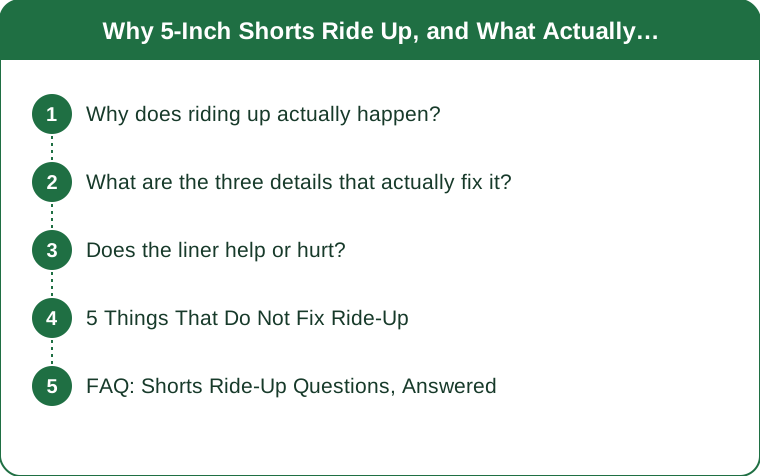
Why does riding up actually happen?
It is a friction problem, and the mechanism is simple once you see it.
As you walk or run, your thighs make contact and separate with each stride. Where there is contact, there is friction between skin and fabric. That friction drags the fabric upward slightly on each stride, because the fabric can move up more easily than down - the leg is tapered, and the thigh gets wider as you go up, so there is somewhere for the fabric to go.
Once the hem has migrated above the widest part of the thigh, it becomes self-reinforcing. The short is now sitting on a narrower part of the leg than its own circumference, so it has no grip at all, and each subsequent stride moves it further.
That is the critical insight: there is a tipping point. Below it, the short is held in place by its own contact with the widest part of the leg. Above it, nothing holds it and it will keep climbing until it reaches the crotch.
Which explains three things people find confusing:
- Why it happens suddenly rather than gradually. You are fine for a mile and then not fine, because you crossed the tipping point.
- Why it is worse when damp. Wet skin and fabric have a higher coefficient of friction than dry, so the drag per stride increases significantly - which is why it is a summer problem.
- Why the same shorts behave differently on different people. Thigh shape determines where the widest point is, and therefore how much margin there is before the tipping point.
What are the three details that actually fix it?
All three are checkable in a shop, and none of them are on the size label.
1. A silicone gripper at the leg opening. The most effective single feature. A thin silicone strip on the inside of the hem increases the friction between fabric and skin at exactly the point where you need the fabric to stay put. It converts the leg opening from something that slides to something that grips.
Check by turning the hem inside out. A gripper is visible and tacky to the touch. Its absence is the single best predictor of ride-up.
2. Fabric with enough weight and structure. A very light, drapey fabric bunches easily and has little resistance to being dragged. Something with a bit more weight and body holds its shape and resists the fold-and-climb pattern. This is a real trade-off against breathability in August heat, and it is worth knowing you are making it.
3. A gusseted crotch. A gusset is a separate diamond or triangular panel at the crotch, replacing the point where four seams would otherwise meet. Without it, the inseam seams pull toward each other under movement, which drags the whole leg opening inward and upward. A gusset also removes the seam bulk that causes chafing at exactly the highest-friction point.
Check by looking at the crotch from the inside. If you see a separate diamond panel, it has one. If four seams converge at a single point, it does not.
All three together is the specification that solves the problem. Any two is usually enough.

Does the liner help or hurt?
It depends entirely on the liner type, and this is where the biggest differences between apparently similar shorts live.
A compression liner - a fitted short attached at the waist. This is the best-performing option for ride-up, because the liner holds against the thigh and the outer short slides over it rather than against skin. Fabric-on-fabric friction is lower than fabric-on-skin, particularly when damp. The liner also entirely eliminates thigh chafing, which is the other half of the problem.
The key detail is that the liner needs its own gripper or it will ride up itself and drag the outer short with it. A liner without a gripper can actively make things worse.
A brief-style liner does nothing for ride-up because it does not reach the thigh contact zone. It is a comfort and hygiene feature, not a mechanical one.
No liner puts fabric directly against skin, which is the highest-friction combination. Unlined shorts need the gripper more than lined ones do.
In August specifically there is a heat argument against the compression liner - it is a second layer on the thigh, in the warmest weather of the year. The honest trade-off:
- For running and anything with sustained thigh contact: the compression liner wins clearly, even in heat.
- For lifting, walking, and general wear: unlined with a good gripper is cooler and sufficient, because the stride frequency that drives the problem is much lower.
5 Things That Do Not Fix Ride-Up
-
Sizing up. The most common attempt and the most reliably counterproductive. A larger short has a wider leg opening, which means less contact with the thigh and therefore less friction holding it down. It reaches the tipping point faster, not slower.
-
Going longer without checking where the hem falls. A 7-inch short helps only if the extra length puts the hem below the widest point of your thigh. If your widest point is high, a longer short simply starts lower and climbs the same distance. Measure where your thigh is widest and buy relative to that, not to a general rule.
-
Anti-chafe balm on the thighs. It genuinely solves chafing, which is worth doing, but it reduces friction - which is the force you were relying on to hold the hem in place. It can make ride-up marginally worse while making the consequence less painful.
-
A tighter waistband. The waistband is not what is failing. Tightening it does nothing to the leg opening and just adds discomfort at the middle.
-
Assuming it will settle after a few wears. It will get worse, not better. Elastane in the leg opening relaxes with wear and washing, so a short that marginally holds when new will typically stop holding after twenty washes. If it is borderline in the shop, it is a no.
The third one surprises people, and it is worth understanding as a genuine trade-off rather than a mistake - chafing hurts more than ride-up, so the balm is often still the right call.
FAQ: Shorts Ride-Up Questions, Answered
Can I add a gripper to shorts I already own?
Partly. Silicone gripper tape sold for garment repair does work, applied to the inside of the hem, though durability through washing is mixed. A more reliable option is having a tailor take in the leg opening slightly, which increases contact - a small alteration that often solves the problem entirely on an otherwise good pair.
Why does it happen more at the end of a run than the start?
Moisture. Dry skin and fabric slide against each other relatively easily; damp skin grips, and each stride drags the fabric further. This is also why it is a much larger problem in August than in October at the same distance and pace.
Is it worse for particular body shapes?
It is more common where the thigh has a pronounced taper and where the widest point sits high, because there is less margin before the tipping point. This is a fit-and-construction issue, not a size issue - grippers and gussets matter more, and length relative to your own widest point matters more than a standard inseam number.
Do bike-short-style lengths solve it entirely?
Largely, yes, because a long fitted short sits well below the widest point and is held by compression along its whole length rather than at a hem. If ride-up is your main frustration, a longer fitted short is the most reliable answer available, and the 5-inch question becomes one of preference rather than function.
TL;DR:
- Ride-up is a friction problem: each stride drags the hem up, and once it passes the widest point of your thigh it climbs freely.
- The three fixes are a silicone gripper at the leg opening, fabric with enough weight to resist bunching, and a gusseted crotch.
- A compression liner with its own gripper is the best option for running; unlined with a gripper is cooler for everything else.
- Sizing up makes it worse by reducing contact, and anti-chafe balm reduces the very friction holding the hem down.
- It is worse when damp, which is why it is a summer problem, and it gets worse as elastane relaxes with washing.
Turn the hem inside out in the shop. Gripper or no gripper answers most of the question in three seconds.
Keep Reading
This article is for general informational and styling purposes only. Fit, sizing, and product availability may vary.